
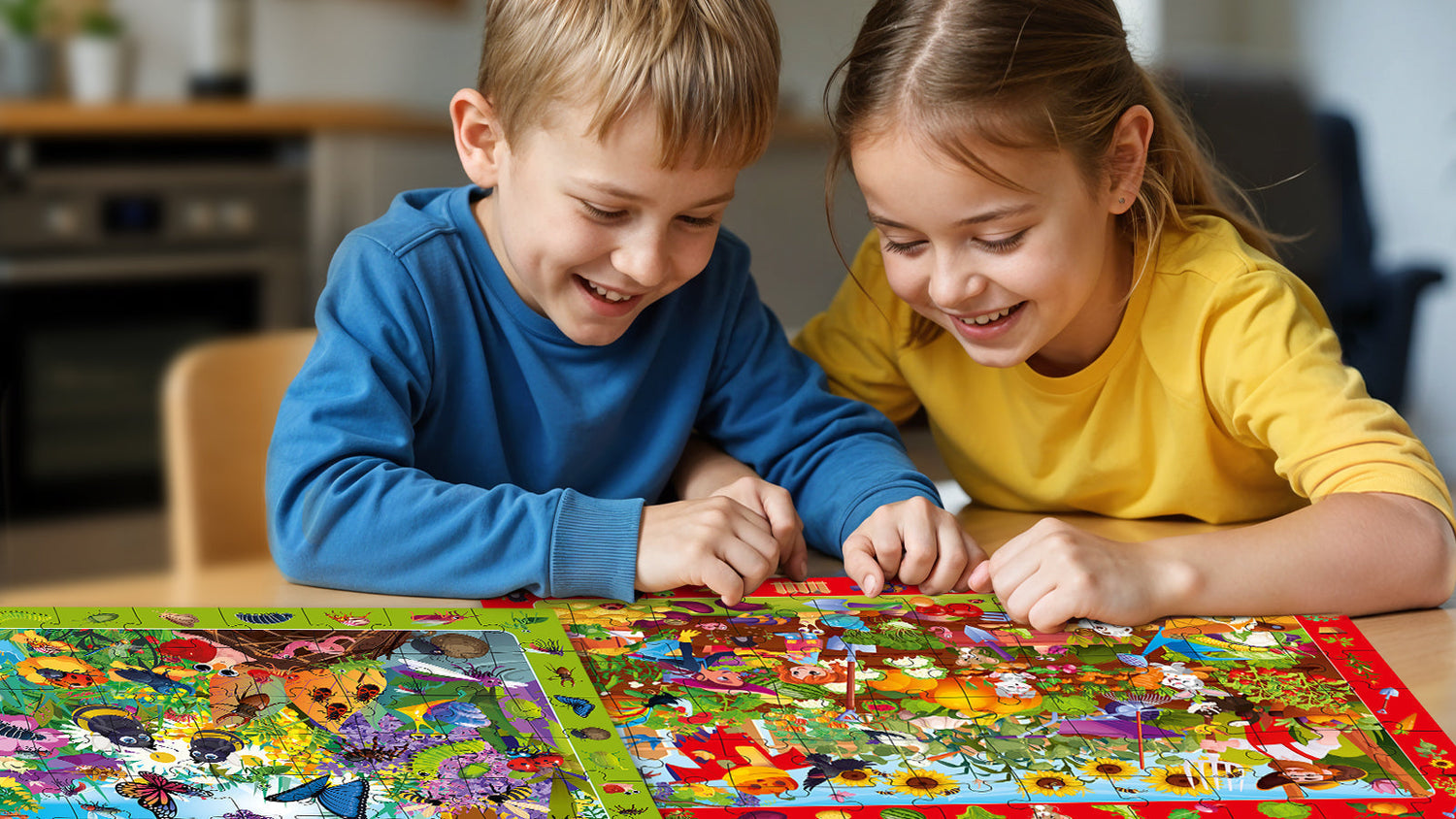
Your four-year-old sits down, works at something for five minutes, and drifts off. And yet the same child can sit motionless with a tablet for forty minutes.
What’s actually going on?
Most children this age hold focused attention for roughly 2 to 5 minutes per year of age, around 8–20 minutes at four, 10–25 at five, and 12–30 at six.
Attention at this age is situational, not fixed. It stretches when three things are true:
- the child chose the activity
- the goal is visible
- the feedback is something they can read without asking an adult
Why most toys for ages 4–6 don’t build focus
A screen doesn’t require sustained attention. It captures it.
Sound, movement and reward arrive without the child generating anything. The moment the input stops, so does the engagement. Sustained attention is the opposite skill — holding yourself inside a task that isn’t entertaining you.
Battery-powered toys work the same way. So do most toys that do something when a child presses a button.
There’s a second reason, and it’s an uncomfortable one. When something needs doing, adults usually do it first. Not out of impatience, as it’s simply faster. But the child never becomes an active participant, so the skill never gets its repetition.
Parents shape this in both directions. The same involvement that builds concentration can just as easily hold it back.
How to improve concentration in your 5-year-old
Thinking at four, five and six is still physical. Children reason with their hands before they reason in their heads. That’s why “just concentrate” is an instruction their brain can’t really act on yet.
Attention needs an anchor. The parent’s real job is to choose an activity that shows a child what independence feels like while building it.
A puzzle piece makes a very good anchor. It sits in the hand. It has exactly one correct home. And it either fits or it doesn’t, with no adult verdict required.
What a puzzle is training while your child plays
1. Grip precision and strength
Your child picks up a piece, turns it, and presses it into place. Those are the same muscles and finger positions that will later hold a pencil.
Board thickness matters more than it sounds. Thin pieces buckle under a small thumb. When a piece bends, the child assumes their hands failed. In fact the cardboard did.

QUOKKA cuts its pieces from a rigid board, sized for small hands. Pressing one home takes real effort — the useful kind.
A child who has placed a few thousand pieces has been practicing a tripod grasp all along. No handwriting drills, and none of the resistance that drills usually provoke.
2. In-hand rotation
Turning a piece with the fingers alone is one of the last fine motor skills to mature. Most children would rather put it down and pick it up again. They only practice it if the piece is worth rotating. Where shapes repeat, children learn to fit pieces by feel instead of by sight.
Every QUOKKA piece is cut on a unique line. No repeats, no simple filler shapes.
So a piece has to be turned in the fingers and compared with the eyes before it goes anywhere. That comparison, judging that two nearly identical shapes are not the same, is the skill that later separates b from d and p from q.
3. Working memory
Holding the shape of a gap in mind while scanning sixty loose pieces is memory under load, and it only works if there’s something specific to hold onto.
A densely illustrated scene gives a child a fragment of pattern to search for rather than a wash of color, which is why the Ocean Creatures, Rainforest and Big City Life pictures ask more of a five-year-old than a single large character on a plain background.
4. Planning
Edges first, then color groups, then detail. Left to themselves, most five- and six-year-olds invent a strategy — that’s executive function developing in real time. Sixty pieces is roughly the point where a strategy stops being optional, and the completed picture printed on the box lid gives them something to plan against.
5. Bilateral coordination
One hand steadies the built section while the other places a piece; occupational therapists name puzzles specifically for this. It only happens above a certain size: when a finished scene is too large to hold in one hand, both hands have to divide the work.
6. Honest feedback
An app celebrates every tap. A puzzle doesn’t. The piece fits or it doesn’t, and the child finds out instantly, by themselves. That only works if the verdict is unambiguous.
That’s why pieces that sit flush with no gaps matter, and why the artwork on the box does real work: your child can check their own answer without turning to you for it. Try, fail, adjust, succeed, repeated a hundred times in one sitting, is where persistence actually comes from.
And when the last piece finds its place, the session doesn’t have to end. Search-and-find scenes hide dozens of small objects inside the picture, so finishing becomes the beginning. It’s the simplest way to stretch a fifteen-minute sitting into thirty.

Which QUOKKA puzzle set for ages 4–6 should you choose?
Everything above points to one specification:
- rigid pieces that don’t bend
- a unique cut line on every piece
- a matte, non-glare surface that keeps detail readable under a lamp
- a box that shows the finished picture
Every QUOKKA 60-piece set for ages 4–6 is built to it. Each box holds four puzzles — enough to keep a routine going for weeks before the novelty runs out. All use responsibly sourced, FSC-certified paper.
Which one you want depends on what you’re after
If concentration is the goal, Search & Find — Polar Animals, Rainforest, National Park and Big City Life is the strongest of the four, because the hunt keeps children at the table long after the puzzle is built.
For a child who needs the picture to pull them in first, there’s Fairy Tale & Princess, or Glow-in-the-Dark unicorns and mermaids, which builds by day and glows at night — useful if you’re trying to turn a bedtime routine into something a child looks forward to.
Bible stories cover Noah’s Ark, the Tower of Babel and the Garden of Eden, and are pitched slightly older at 5–8.
Not sure? Start with Search & Find. The hidden objects keep the session going after the last piece is in.
How many puzzle pieces for a 4, 5 or 6 year old?
| Age | Piece count |
|---|---|
| 3–4 years | 24–30 pieces |
| 4–5 years | 48 pieces |
| 5–6 years | 60 pieces |
| 6+ | 100 pieces |
Sixty pieces suits most fives and sixes.
Drop to 48 pieces if your child gives up inside two minutes. That’s almost always a difficulty problem rather than an attention one.
Move up to 100 pieces once sixty stops taking twenty minutes.
Frequently asked questions
How long should a 5-year-old be able to concentrate? Around 10 to 25 minutes of an activity they chose themselves. On something an adult assigned, four to six minutes is normal. Both figures are typical.
What size puzzle is right for a 4-year-old? Most four-year-olds do well with 48 pieces. Move to 60 at around five, once 48 stops being a challenge. If your child gives up in under two minutes, drop a level rather than pushing.
Why can my child focus on a tablet but not on a puzzle? A screen captures attention rather than requiring it. Sound, movement and reward arrive without the child sustaining anything. A puzzle asks them to hold themselves in a task, which is a different skill entirely.
Do puzzles really improve concentration? They give children repeated practice at sustained attention, with a visible goal and instant feedback. That’s how attention span gets exercised. The difficulty level has to be right, though.


Leave a comment
All comments are moderated before being published.
This site is protected by hCaptcha and the hCaptcha Privacy Policy and Terms of Service apply.