
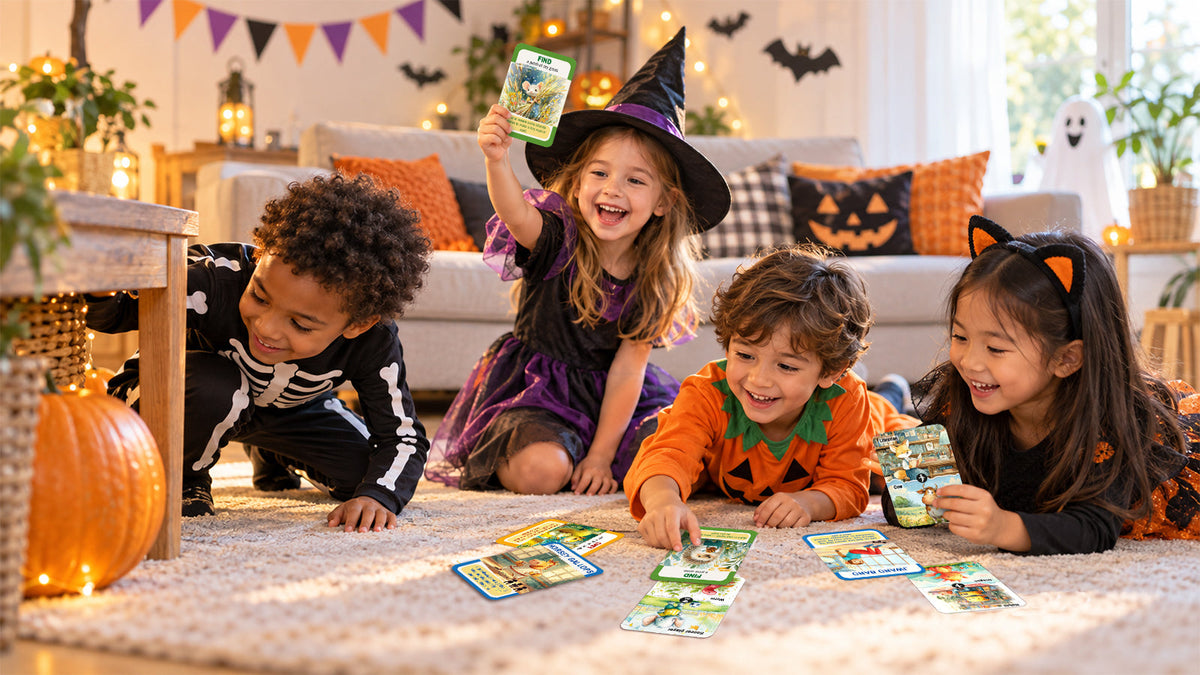
Halloween party playbook · Sat, Oct 31
Every kids’ Halloween party goes sideways at the same four moments. None of them has much to do with sugar.
It’s twenty to five on Halloween afternoon. There are eleven children in your living room, and three of them are dressed as the same superhero. A pirate is hitting a ghost with a foam sword. A very small witch is crying because her hat is “wrong.” Somebody’s dad leans in the kitchen doorway, surveys the room and delivers the verdict every adult at every Halloween party has delivered since the invention of the mini candy bar:
“It’s the sugar.”
The candy bowl is still sealed. Nobody has eaten a thing.
This year the afternoon will be longer than usual, because Halloween 2026 falls on a Saturday. There’s no school to use up the day. Costumes go on after lunch, the neighborhood kids start drifting over by mid-afternoon, and trick-or-treating doesn’t really begin until it’s dark. That leaves hours of children in full costume, fully wound up, with nothing to do but wait.
The part of that afternoon that goes wrong is also the part you can fix, and it isn’t the part everyone blames. It’s less about finding the perfect Halloween party games for kids and more about where you put them.
The sugar rush that wasn’t
In 1994, psychologists Daniel Hoover and Richard Milich ran a study with 35 boys aged five to seven and their mothers. Every mother had described her son as “sugar sensitive.” Every boy got the same placebo, sweetened with aspartame — no sugar at all. But one group of mothers was told their son had just had a large dose of sugar.
Those mothers rated their sons as significantly more hyperactive. They behaved differently, too: they kept physically closer to their sons and tended to watch them, talk to them and criticize them more. The boys hadn’t changed. The adults’ expectations had.
1994 · Hoover & Milich
0 g
of sugar. All 35 boys got a placebo, yet the mothers told “sugar” rated their sons more hyperactive.
1995 · JAMA meta-analysis
23
blinded, placebo-controlled studies. Sugar did not affect children’s behavior or cognitive performance.
A year later, a meta-analysis in JAMA pooled 23 blinded, placebo-controlled studies and reached a blunt conclusion: sugar does not affect the behavior or cognitive performance of children. The authors allowed that a small effect in some children couldn’t be ruled out — but nothing resembling the transformation parents describe every October.
So what is winding up that living room? Researchers who study early-childhood classrooms have an unglamorous answer. In an article for NAEYC’s journal Young Children, they note that challenging behavior is more likely when transitions are too long and children spend too much time waiting with nothing to do, and when there are not clear instructions.
Now read that with a Halloween party in mind.
- Waiting for friends to arrive.
- Waiting for the pizza.
- Waiting for it to get dark.
- Nobody quite sure what happens next.
A kids’ Halloween party is an afternoon built almost entirely out of waiting — and the candy gets blamed for what the schedule did.
The fix isn’t less candy. It’s fewer gaps.
Four moments where a Halloween party goes sideways
You don’t need fifteen activities. You need something ready for each of the four moments when a party tends to tip over — and something that fits the ages in the room, because Halloween parties are almost never one age. They’re a four-year-old little sister, three second-graders and an eleven-year-old who is far too old for this and came anyway.
Moment 1 · Arrival
The door: the first twenty minutes
Guests never arrive together. They come in ones and twos, in costumes they’re suddenly shy about, and half of them have never met. The early arrivals are the real risk: two kids who’ve been waiting twenty minutes for a party to start will start one of their own, and you won’t like it.
What works here is a game with no entry requirements. Nobody should need to know anything, be good at anything or have been there from the beginning. That rules out trivia and most board games, and it points straight at choices. What Would You Choose? is built on would-you-rather-style questions, which have no right answers — only answers you have to defend. It sets up in under a minute, it’s made for ages five and up, and a late arrival can take the next card without anyone stopping to explain the rules.
The real work happens after each answer. “Wait — why?” is the fastest icebreaker there is, and two strangers arguing about something ridiculous have usually stopped being strangers by the third card. The cards are waterproof and tear-resistant, which matters more than you’d think within splashing distance of the punch bowl.
Make it Halloween
Everyone answers the way their costume would. The vampire and the astronaut rarely agree on anything.
Moment 2 · Peak energy
The peak: when the energy has nowhere to go
About forty minutes in, the room warms up. The volume climbs, the foam swords come out, and games start inventing themselves — usually some version of chasing. You can’t talk that energy down, and there’s no point trying. Give it a job instead: rules, a clock and a scoreboard.
The Challenge Game Set has 250 task cards across five categories and three difficulty levels, and it comes with its own props — cups, balls, buttons and dice — so nobody has to raid your kitchen drawers. Teams stack, flip, balance and bounce against each other, loudly, but inside the rules. Some cards are played blindfolded. Others are silent missions, which at a Halloween party is close to a miracle.
It’s rated eight and up and built for a crowd of up to fourteen players, so it’s the natural home for the older half of the room. If your party skews young, make this the station the big kids run while the little ones head out on the hunt below.
Make it Halloween
Since the candy isn’t the problem, let it be the scoreboard. Every challenge won earns one piece — for later.
Moment 3 · Before dark
The hour before dark
This is the stretch nobody plans. The pizza is gone, the costumes are all the way on, and trick-or-treating can’t start until it’s dark enough to feel like Halloween.
Kids who can see the finish line but aren’t allowed to cross it are the hardest kids in the world to keep calm.
So send them out with a mission: a Halloween scavenger hunt. The Hunter Walker Scavenger Hunt comes with two walkie-talkies, two treasure bags, three colored team bracelets and 200 cards — 100 for outdoors, 100 for indoors — split into junior and senior levels. That split is what makes it work at a mixed-age party: the youngest hunters get junior cards, the older ones get senior cards, and they’re out in the same yard at the same time.
Hand the second walkie-talkie to an older kid at “base” to read out the next card. The big kids get to be mission control; the little ones get to say “Over!” as often as they like. Set the boundary before the first card — the fence, the driveway, the porch light — and keep an adult within sight.
If it rains, switch to the indoor cards. Nothing else about the plan has to change.
The last-light mission
Hunter Walker Scavenger Hunt
- Ages 4–8
- 2 walkie-talkies
- 100 outdoor + 100 indoor cards
Make it Halloween
The last thing on the list is always the candy bowl.
Moment 4 · After trick-or-treating
After trick-or-treating: the second wind
Trick-or-treating ends, everyone piles back inside, and the room splits on its own. The little ones want to tip their bags onto the floor and sort, count and trade — let them; it’s the calmest they’ll be all day. The older kids, and the parents who stayed, want something louder.
That’s the moment for What’s That Sound?: 180 cards and 330 sound challenges, from animal noises and city sounds to awkward situations and character impressions. You draw a card, roll the Mode Die to find out how you have to perform it, and your team guesses before the sand timer runs out. It’s made for ages ten and up and two to eight players, which makes it a big-kids-and-grown-ups game — one of the rare ones where parents and older kids play on equal terms, and the parents don’t always win.
Make it Halloween
Dim the lights and hand the performer a flashlight. Every sound is creepier lit from under the chin.
rule
#1
One rule for the adults
Don’t say “it’s the sugar” in front of the kids.
Not because it’s rude, but because of what happened in that 1994 study. The mothers who believed their sons were full of sugar stayed closer to them and tended to watch and criticize them more. Expectation changes how adults treat children, and children respond to how they’re treated. A party where the grown-ups are braced for chaos usually gets some.
Watch the schedule instead of the candy count. If the next thing is always ready before the last thing ends, the afternoon mostly runs itself — and the only person who needs to be told to calm down is the dad in the doorway.
Questions parents ask
What are good Halloween party games for kids?+
How do you keep kids entertained at a Halloween party?+
Does sugar really make kids hyper?+
What Halloween games work for mixed ages?+
What’s a good Halloween game for kids who don’t know each other?+
What if it rains on Halloween?+
Happy haunting!
Give every moment a game.
Party games for the door, the peak, the hour before dark and the second wind.
Browse party games →


Leave a comment
All comments are moderated before being published.
This site is protected by hCaptcha and the hCaptcha Privacy Policy and Terms of Service apply.