
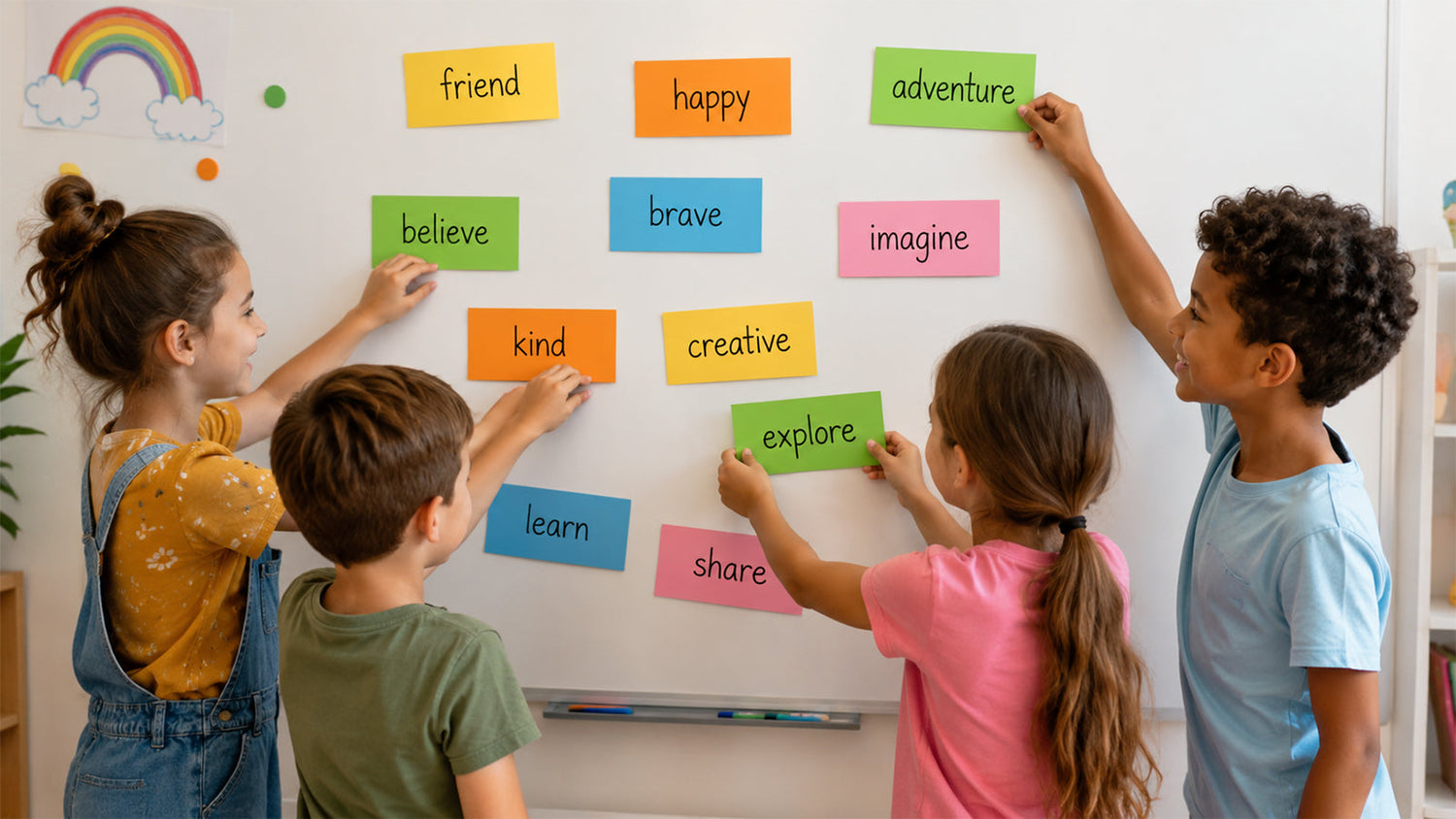
A word wall is one of the most common fixtures in a K–2 classroom, and one of the most quietly frustrating. You laminate the cards, sort them by color, staple them up under a hopeful WORDS WE KNOW banner, and your class can chant every word on it. Then a child sits down with a real book and the same word falls apart. If that sounds familiar, the wall isn't the problem. The way sight words usually get taught is.
Kids read the wall, not the page
Imagine a first grader; let's call him Marcus. During the classes he chants the words posted on the wall along with everyone else: "said," "come," "friend," loud and confident. Ten minutes later, at the guided reading table, he stalls on "said" in a book as if he's never seen it. He guesses. "Sit? Sad?" He looks up at the wall, hunting for it.
It's one of the most common gaps in early reading: a child who "knows" a word in a drill but can't read it in a sentence. This occurs due to a lack of interaction with vocabulary.
When children are asked to memorize words as shapes, those words don’t transfer, because a word memorized in such way doesn’t translate to the page. In other words, the child doesn’t form strong enough neural connections for that specific word.
What actually makes a word stick

Reading research, usually grouped under the term "the science of reading," points to a process called orthographic mapping. A word becomes automatic when a child connects the sounds in it to the letters that spell them, and links both to what the word means. Sounds, letters, and meaning lock together into one unit the brain can pull up instantly. Staring at a word's shape never builds that unit. Four steps do.
- Link sounds to letters. Before a word takes its place on the wall, children say it slowly, count the sounds, and match each sound to its letters. Some high-frequency words have a part that breaks the usual rules; mark that part. Many teachers call these "heart words," because the tricky bit has to be learned by heart.
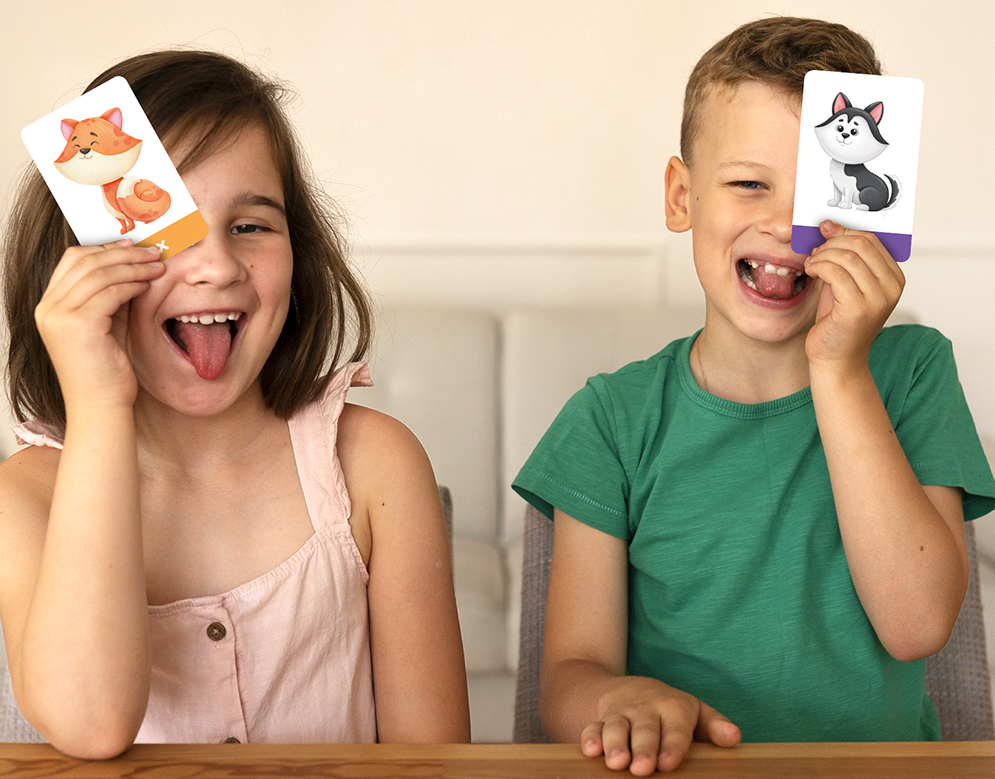
- Anchor the meaning. A word has to mean something, not just look like something. Pairing it with a picture gives young readers a hook to hang it on, so the word connects to a real idea instead of floating free as a row of letters.
- Put it in context. Seeing a word in a real sentence shows children what function it serves, and this is precisely what avoids dry memorization. When reading about an “apple” that fell from a “tree” and rolled away, children don’t just memorize the word, they picture an active sequence of events, which helps them associate the word with real-life meaning.
- Write it down. Forming the letters by hand is part of how the connection locks in. Building and spelling a word, instead of only recognizing it, makes a child think through every sound and letter in order. When a child interacts with each letter of a word, they gain yet another hand-eye coordination skill.
Only once a word is mapped does rapid recall practice make sense, and this is where flash cards genuinely shine: quick, low-pressure repetition that builds speed. The order is everything. Map the word first, drill for fluency second. And grouping students by the level they're actually on, rather than the level the calendar assigns, keeps everyone working on words they're ready for.
What it looks like in practice

A strong small-group routine treats the card as a starting point, not a memory test.
Start with the picture and name it. Say the word slowly and count the sounds on fingers. With "friend," find the parts that behave and the part that doesn't (that silent "i" is the heart). Read the word inside the sentence on the card so it lands with some meaning. Then each child writes it on a wipe-clean card, saying the sounds while writing, wipes it, and does it again. Two minutes a word, give or take.
A few days later, the same words come back as a speed round with plain, picture-free cards. By then they're mapped, so the drill finally does what a drill is meant to do: make reading them fast and effortless.
Back to Marcus. A few weeks of this and he hits "said" in a book and simply reads it. No glance at the wall. He doesn't even notice he's done it, which is exactly the point. The word has moved off the wall and into him.
The cards that fit the routine
That routine needs the right tools: a picture for meaning, a sentence for context, and something kids can write on. Quokka's 520 Sight Words line was built around those needs. Every set is based on the Dolch and Fry lists and split into five color-coded levels for Pre-K through 3rd grade, so you can hand each small group the exact level they're on, and the rings let you pull a level in seconds.

The line comes in three versions, each suited to a different job:
Same 520 words, three jobs, in the right order: meaning first, writing to lock it in, speed last.
If you're setting up your classroom this year and looking at a beautiful, not-quite-working wall, the shift is a simple one: stop asking kids to memorize the shape, and start giving every word its sounds, its meaning, and a chance to be written by hand. The cards don't do the teaching. They just make the good kind easier.
Frequently Asked Questions
High-frequency words that show up constantly in text (the, was, said, come, friend). Most come from the Dolch and Fry lists.
Not as shapes. Words become automatic through orthographic mapping — linking sounds, letters, and meaning. Cards help most when they support that, not replace it.
"Heart words" are high-frequency words with an irregular part that breaks spelling rules; you learn that part "by heart" while still mapping the regular sounds.

Yes, for the right jobs: introducing a word with a picture and sentence, practicing spelling, and building speed once the word is mapped.

Leave a comment
This site is protected by hCaptcha and the hCaptcha Privacy Policy and Terms of Service apply.