
c. 3100 BC — tonight
Board games are older than most religions, older than most alphabets, and older than every country currently playing them.
Open an ancient grave and you expect weapons, jewelry, pots, and the practical equipment of life. What turns up surprisingly often is a game.
Tutankhamun was buried with several. Queen Nefertari was painted playing one on the wall of her tomb. In the royal graves at Ur, in what is now southern Iraq, archaeologists found beautifully made boards inlaid with shell and lapis lazuli, packed in among the things the dead were expected to need. Whatever else people thought the afterlife would be, they were not prepared to arrive there without something to play.
That tells you what games were.
Senet · the Royal Game of Ur
The oldest ones we can still play
The Egyptian game was senet, and it goes back to around 3100 BC: thirty squares in three rows of ten, pieces racing to the end, movement decided by throwing sticks rather than dice. It began as entertainment and slowly turned into something much heavier. By the New Kingdom, Egyptians had come to see the board as a map of the underworld and the game as a rehearsal of the soul’s journey through it. A game people had played for fun for a thousand years quietly became a religious text.
Older still is the Royal Game of Ur, played in Mesopotamia around 2600–2400 BC — roughly 4,600 years ago. More than a hundred examples have been dug up across the Middle East and the Mediterranean, which is the ancient equivalent of a game being in every house on the street.
And here is the part that still seems unreasonable. In 177 BC, a Babylonian astronomer wrote the rules down on a clay tablet. That tablet survived. In the 1980s, a curator at the British Museum named Irving Finkel worked out what it said. Which means that a game abandoned for thousands of years — whose civilisation is gone, whose language nobody speaks — can be played tonight, correctly, on your kitchen table.
China · India · Africa · Mesoamerica
Everybody invented one, and everybody made it mean something
What’s striking isn’t that one culture came up with this. It’s that all of them did, independently, and then treated it as far more than a pastime.
In China, a game called Go (weiqi) is around three thousand years old and was so highly regarded that it became one of the four arts a scholar-gentleman was expected to master, sitting alongside calligraphy, painting and music. Not a hobby. An accomplishment on the level of art.
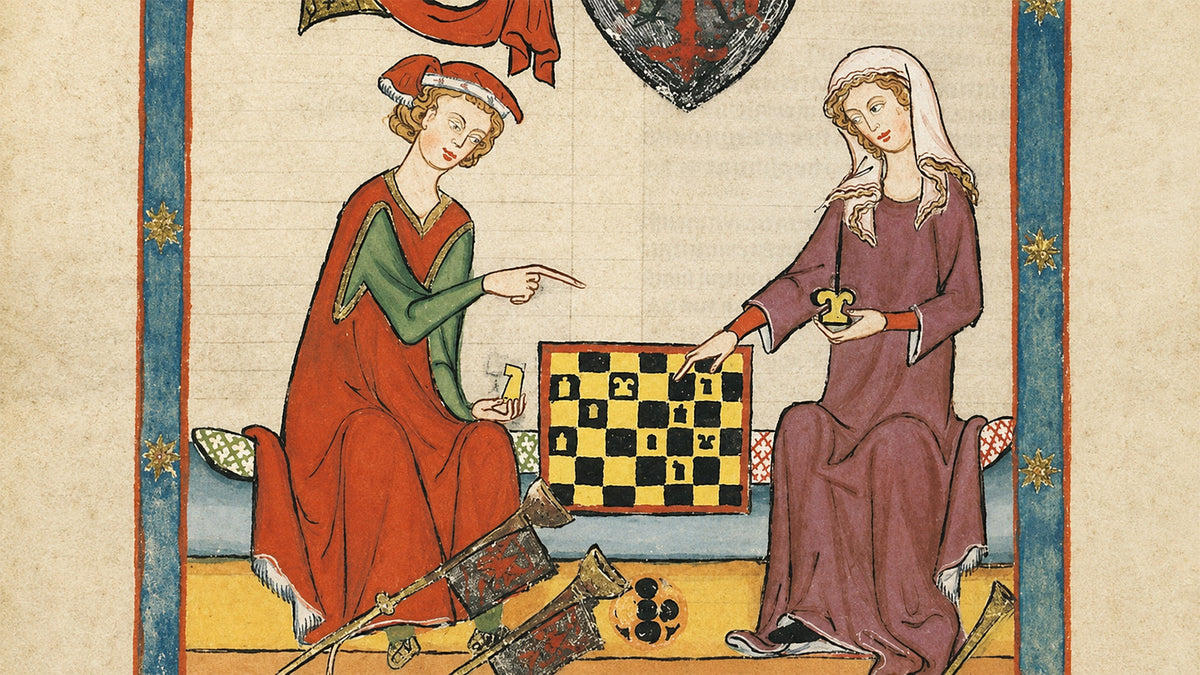
In India, sometime around the sixth century AD, someone invented chaturanga (modern chess), named after the four limbs of an army: infantry, cavalry, elephants, chariots. Persian merchants carried it home, where it became shatranj, and from there it travelled into the Islamic world and on into Europe, changing as it went. The counsellor who stood beside the king slowly turned into a queen, and by the end of the fifteenth century she had become the most powerful piece on the board. The game rewrote itself to match the politics of wherever it landed.
Across Africa, the Middle East and Asia, the mancala family of games spread using nothing but seeds and holes scooped in the ground — a design so portable it barely requires objects at all. In some cultures the goal wasn’t even to win; keeping the game going mattered more than finishing it.
In Mesoamerica, the Aztecs played patolli, and they played it for stakes: goods, currency, and on occasion a player’s own freedom. When the Spanish arrived in the 1520s and 30s, they hunted down the mats and the playing beans and destroyed them. It is worth pausing on that.
Somebody decided a board game was dangerous enough to be worth burning.
Meanwhile in Scandinavia, the Norse played hnefatafl, in which the two sides are deliberately unequal: a king and his defenders against roughly twice their number. And around 1400 BC, Egyptian workmen scratched a nine men’s morris grid into stone at their work site — the oldest surviving evidence that somebody, somewhere, was bored at their job.
Moksha Patam · The Landlord’s Game
Games are arguments in disguise
Once you notice it, you can’t stop seeing it: people have always used games to say things they wanted said.
Snakes and Ladders began in India as gyan chauper, or Moksha Patam, and it was never about the finish line. Ladders were virtues, snakes were vices, and the square at the top was liberation. Hindu, Jain and Muslim versions all existed, each mapping its own moral universe onto the grid. The game reached England in the 1890s, where the virtues and vices quietly fell off it and it became a race about numbers, which is how most British children met it.
The best example is more recent. In 1904, an American named Elizabeth Magie patented The Landlord’s Game. She built it as a demonstration — she wanted players to feel, in their own money, what land monopoly does to everyone else. It shipped with two sets of rules: one in which wealth was shared as it grew, and one in which a single player was allowed to take everything.
Three decades later, her design reached Parker Brothers via a man named Charles Darrow and was published, in 1935, as Monopoly. Magie was paid $500 and effectively erased from the story for forty years. And of her two rule sets, the world adopted the one where somebody wins by ruining everybody else — and made it the most famous board game on earth.
The rule that decided everything
What actually survived?
Empires, languages and religions all fell away from these games. The games didn’t.
And the ones that lasted longest have something in common: anybody could join. Senet and the Game of Ur are races — you don’t have to be clever, you have to be lucky and pay attention. Mancala needs no equipment. Snakes and Ladders needs nothing but the ability to count. The games that vanished were mostly the complicated ones.
Which is the same rule that decides what actually gets played in a house today, five thousand years later.
Five thousand years later
What that looks like on a modern table
-
Don’t BEE Last
The race — senet, the Game of UrLuck matters more than skill, and a child can beat an adult honestly. Everybody moves, anybody can win, and it can be explained faster than it can be set up.
-
Higher or Lower
The wager — patolliWill the next one be more, or less? The whole pleasure is committing to a guess out loud and being publicly wrong. A much safer descendant of a game once played for a player’s own freedom.
-
Who Knows Generations Better?
The talking gameIt does deliberately what those ancient tables did by accident: it puts several generations around one surface and lets them argue about whose era was better.
-
Search & Find puzzles
Nobody competes — mancala’s quiet cousinKeeping it going matters more than finishing. Made for the smallest players, who work standing up and shouting.
Five thousand years is a long run for any human habit. Very few of them are this easy to continue.



Leave a comment
This site is protected by hCaptcha and the hCaptcha Privacy Policy and Terms of Service apply.