

The average person spends around five hours a day on their phone. It's between four hours and forty minutes or five hours and sixteen minutes, and it's been climbing every year since anyone started measuring. Statistics say people usually use their phones between 21:00–02:00 that is called ‘night scrolling’ and near 11:00-14:00 - ‘rest scrolling’, but does it matter?
Most of us would say we enjoyed it. You weren't suffering, you just were watching cat videos, reading a thread about someone's terrible landlord, watching a stranger renovate a van. It felt like fun, and definitely it felt like rest.
So why does it never feel like rest afterwards?
Scrolling gives you the anticipation of reward without much of the reward itself, you get the wanting, not the having. That's why three hours of it leaves you flat instead of full. To cut it down, don't try to want your phone less. Fill the specific slot where you scroll with something that starts fast, involves other people, and ends on its own.
Your phone pays you in wanting, not liking
There is no good dopamine and no bad dopamine in reality. It's one chemical. The difference is what it's paying you for.
Dopamine is less about pleasure than most people think. It's the wanting signal — the pull toward a thing, the anticipation of it. Pleasure, the actual liking, runs on a different and much smaller system. Which means you can build something that generates enormous wanting and almost no liking, and a person will use it for five hours and stand up feeling nothing.
That's a feed. Every swipe is a small maybe. Maybe this one's good. The maybe is the product.
However, when you play a table game or solve riddles you have a choice, scrolling doesn’t give you any opportunity. It just throws you colorful options that you maybe enjoy.
⚖️ Why the effort-to-reward ratio decides everything
Compare two evenings. You play a game with friends: you laughed, someone told a story you'd never heard, you have a thing to reference next week. But it cost you something: you had to show up, pay attention, be a person out loud, take time to gather together.
Or you scroll for three hours. The reward is thin and it costs you nothing. You take the phone out of your pocket.
Your brain notices the price tag. Given a free option and an expensive one, it takes the free one every time — and the free one is right there, always, with no wait. That's not weakness. It's arithmetic, and the arithmetic was designed that way.
Well, how do you feel ten minutes after?
After the game night, you're tired in a good way, your emotions are long-lasting. After three hours of scrolling, there's a specific flatness — you can't remember much of what you saw, and you're vaguely annoyed at yourself. That flatness is the receipt. It's the gap between how much you wanted it and how little it gave you.
🚫 Why "just use your phone less" never works
You've tried. Everyone's tried. You deleted the app and reinstalled it on Thursday. You set a screen-time limit and tapped "ignore" so many times it stopped feeling like a limit.
The reason isn't discipline. It's that you removed something without putting anything in its place.
Most scrolling doesn't start because you decided to scroll. It starts in a gap. The ten minutes after dinner. The pause while someone's in the shower. The stretch after everyone's home and nobody's said what the evening is.
The phone is just the fastest thing available. Whatever gets to the gap first, wins. That's the whole mechanism, and it's also the way out.
The rule: replace, don't restrict
Stop asking how do I scroll less. Ask what's good enough to beat my phone at 9pm on a Tuesday.
Not everything qualifies. In practice it has to clear four bars:
- Starts in under two minutes. If setup takes longer than opening an app, the app wins.
- Involves at least one other person. Solo replacements compete with the phone. Social ones don't, you can't quietly drift off mid-conversation without someone noticing.
- Ends on its own. A round finishes. You want the thing to stop by itself, so you don't have to find willpower twice in one night.
- Runs without a screen. The moment it needs someone's phone for a timer or a song, the door is open again. Someone will "just check one thing." You know who.
That filter quietly rules out a lot. Watching something together fails two bars — no ending, no participation, and phones come out within fifteen minutes. Most board games fail the first: by the time you've explained the rules, you've lost the room.
What passes: conversation, cooking together, a walk, and card games. Which is why game night keeps showing up in every article about screen time.
🃏 So what do you actually play?
Fast question games. Someone reads a card, everyone talks over each other, a round takes three minutes. No board, no setup, no app — and they work with whoever happens to be in the room.
Two or three of you
Music trivia is unreasonably good with small groups, because it stops being a game almost immediately. Nobody can hear a question about a song from 2003 without telling a story about 2003.
QUOKKA's "Who Knows Hits Better?"
500+ questions spanning the 90s, 2000s and recent hits, with five different round types — so the game changes shape depending on who's at the table.
Name the Artist, Sing It or Lose It, True or False, Multiple Choice and Special Questions. A round can take thirty seconds or the whole evening, depending on how competitive your people get.
Get it on Amazon →A bigger group
Groups need range. Nothing loses half a room faster than a question set only two people know.
"Who Knows Music Better?" — the 4-pack box
Four separate games in one box: World's Greatest Hits, 90s & 2000s Hip-Hop & R&B, Back to 90s R&B, and a lyrics edition.
That's enough range to outlast the "we've seen all of these" problem that kills most games by the third night — and enough variety that the shy people find a round they're good at.
Get the 4-pack on Amazon →If your group leans one way, the focused editions hit harder. Lyric formats in particular are the most reliable way to get non-singers singing, which sounds minor and absolutely is not.
If there are kids in the house
Mixed-age evenings die when the youngest person can't win. They wander off, they find a screen, and the evening splits back into everyone alone in the same room. Short, luck-weighted card games fix this: quick rounds, few rules, everybody active every turn.
Don't Bee Last
Built for exactly the mixed-age problem — fast enough that losing doesn't sting, simple enough that nobody needs the rules explained twice.
Play it while the kids are still up, then move to trivia once they're down. Two games, one evening, zero phones.
Get it on Amazon →🧩 And if you live alone?
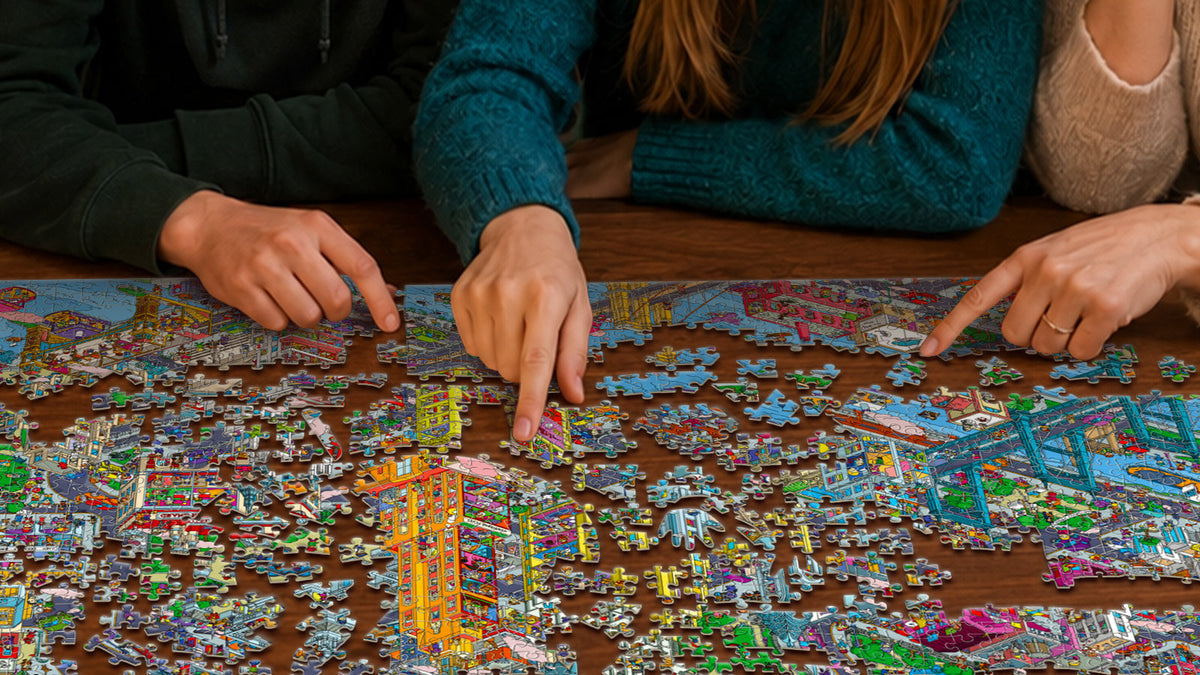
A game needs people. A walk needs you to find your shoes. A puzzle sits half-finished on the table — and half-finished is exactly the point. It has a visible next step, which is the one thing the stretch between dinner and bed is missing. You sit down for five minutes, find three pieces, and twenty minutes are gone without a single swipe.
It's the exact opposite trade to a feed. A puzzle costs you a bit of attention and hands back something finished you can look at. Scrolling costs nothing and hands back nothing. That's the whole difference in one object.
QUOKKA 1000-piece "Cruise Vistas"
Hidden-object puzzles hold attention far longer than a plain image, because you're always chasing a small goal instead of sorting a thousand pieces of identical sky.
The pieces are cut with no repeating shapes, which matters more than it sounds: it's the difference between solving and brute-forcing. And when the picture's done, two sealed envelopes give you a reason to sit back down.
Get it on Amazon →✋ Five habits that make the swap actually stick
Owning the right thing is half of it. The other half is where you put it and when you decide:
- 1Pick one night, not every night. Commit to a phone-free evening every day and you'll fail by Wednesday and decide the whole idea doesn't work. Protect the night you scroll through hardest — usually Friday or Sunday — and add a second once the first stops feeling like a project.
- 2Give the phones a specific address. "Away" is vague, and vague loses. A bowl on the counter, a drawer, the shelf by the door. The phone should cost you standing up, walking, and coming back.
- 3Have it on the table before the gap opens. This is the step everyone skips. Whatever's replacing the scroll has to be physically out of the box before the evening starts drifting. Decide at 6pm, not at 9pm when thumbs are already moving.
- 4Start with the shortest thing you own. A three-minute round beats a forty-minute setup every time. Momentum is easier to extend than to create.
- 5Stop while people still want more. Ending on a high note is what gets someone asking to play again next week — which is the only thing that turns one evening into a habit.
How you'll know it's working
Don't check the screen-time app. Checking it means opening the phone, and you know how that ends.
Better signals, two or three weeks in: you reach for the phone in the gap and notice yourself doing it — noticing comes before stopping. Evenings feel longer: same hours, more of them accounted for. And you go to bed at a time you chose instead of a time you drifted into.
The number will move. It just moves as a side effect, not as a target.
💬 Common questions
Is scrolling actually bad for you, or is that just panic?
Neither, exactly. The issue isn't the content. Feeds are built to maximise anticipation and minimise effort, so you get a lot of wanting and not much satisfaction — which is why hours of it can leave you flat rather than rested. Moderate use isn't a problem. The problem is when it absorbs the hours you'd have spent on things that pay you back.
Is there such a thing as good dopamine and bad dopamine?
No. It's one system, and it's mostly about wanting rather than pleasure. What differs is the effort-to-reward ratio. Scrolling is nearly free and gives back very little; things that cost you some effort — a conversation, a game, a walk — tend to give back more.
How do I limit scrolling time without deleting apps?
Replace the slot instead of removing the tool. Work out when you scroll most, decide in advance what fills it, keep that thing physically ready in the room, and put your phone somewhere that costs you a walk.
What should I do instead of scrolling in the evening?
Anything that clears the four bars: starts in under two minutes, involves other people, ends on its own, and doesn't need a screen. Card and question games, cooking together, walks, puzzles.
How long before the habit actually breaks?
Two to four weeks before the automatic reach fades, and longer if you try to change every evening at once. One evening a week sticks far better than an all-or-nothing reset.
Do screen time limits and app blockers work?
As friction, yes. As a solution, no. A limit you can dismiss with one tap is a speed bump. They work when paired with a replacement and fail as a standalone fix.
Put something on the table before 9pm
One night a week, a deck of cards where the phones usually sit. That's the whole method.
Get "QUOKKA Trivia Games" →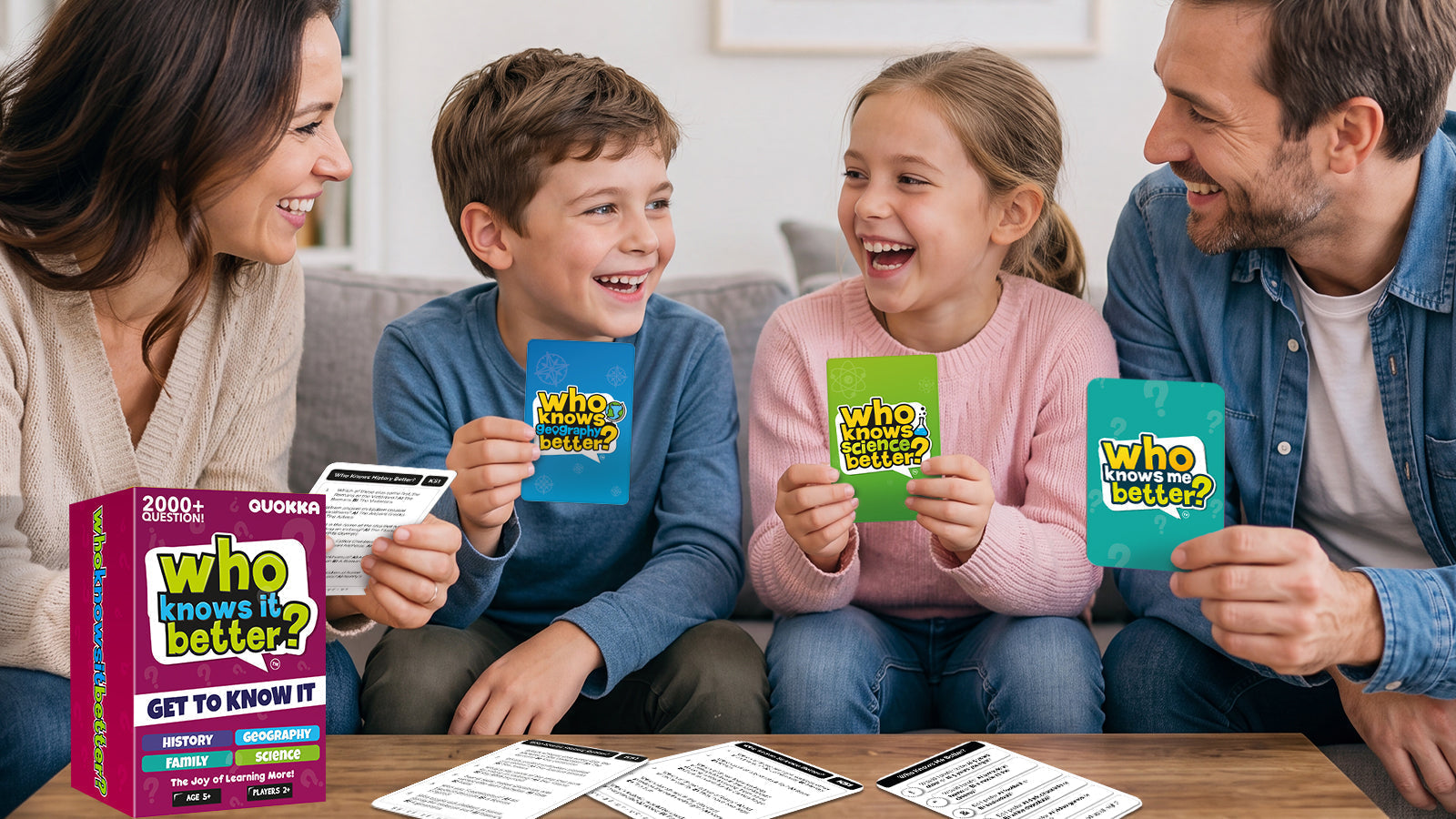

Leave a comment
All comments are moderated before being published.
This site is protected by hCaptcha and the hCaptcha Privacy Policy and Terms of Service apply.