
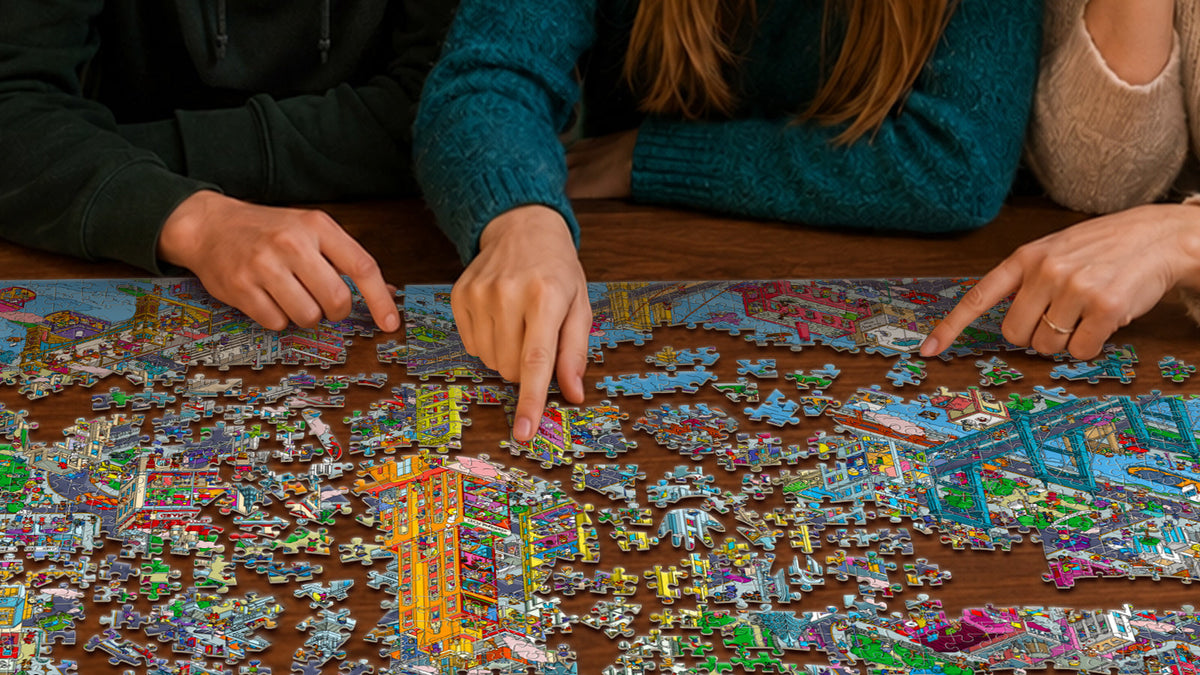
Phase 01 / Build it · Phase 02 / Find things in it

A regular puzzle has one ending. The last piece goes in, someone says "done," and it goes back in the box. An observational puzzle is only half finished at that point.
The build is the same. The second half is not.
Any good floor puzzle teaches the same core things: matching edges, rotating a shape in your head, working from the border inward, and staying with something long enough to finish it. Those are real skills and we are not talking anyone out of a classic puzzle.
The difference shows up after the picture is complete. An observational puzzle is illustrated as a dense scene, so once it is assembled the child has a second task: find the cat on the roof, the boy with one shoe, the six hidden apples. The building phase trains the hands and the spatial sense. The searching phase trains the eyes and the mouth.
It teaches the eye to search in a pattern
Young children search randomly. They stab at the middle of the scene, then at a corner, then back to the middle, and give up because they have already looked there twice without realising it.

Left to right, then down a row, then again. That sweep is the same eye movement reading a line of text requires, which is why occupational therapists use search tasks with children who lose their place on the page.
Two related skills come along with it. Figure-ground discrimination is separating one thing from a cluttered background. Visual discrimination is spotting that two nearly identical things are not identical, which is exactly what "b" and "d" ask of a new reader.
It turns looking into talking
This is the part parents notice first. A silent puzzle becomes a loud one.
To tell someone where you found the umbrella, you have to say behind, under, next to, on top of. To explain why the scene is funny, you have to describe what should be happening and what is happening instead. Kids invent whole storylines about the tiny characters in the corner, which is oral language, sequencing and inference dressed up as a game. You cannot get that from a photo of a puppy in 60 pieces.
It rewards slowing down
Most puzzle time is grab-and-try. Searching only works if you look before you point. For a four-year-old, holding a target in mind ("I am looking for the striped hat") while ignoring everything else is real work: that is visual working memory and impulse control, the same muscle they use when a teacher gives a two-step instruction.

Three things are hidden in there: a ladybird, a star and a key. Find them before the counter fills in. Notice what your own eyes did, because you probably swept the panel in rows. A four-year-old jumps around instead.
It does not end
A construction puzzle is solved once. After that, the child is repeating a route they already know. A seek-and-find scene stays playable, because you can change the target: race to find five red things, take turns naming something the other person has to find, hunt in one quadrant only, do it against a timer.
That is the practical argument as much as the developmental one. Four puzzles that stay interesting for two years beat one that gets solved on a Tuesday.
Choosing by age
The grids below are drawn to scale: one square, one piece.
60 pieces · floor format
Ages 4–6
Big pieces, room to spread out on the rug, and the whole body involved instead of hunching at a table. Four scenes in one box, so you can rotate them instead of burning through all four in a weekend.
Shop 4×60 observational sets100 pieces · floor format
Ages 6–8
The build takes long enough to feel earned, and the scenes carry more detail to hunt through once it is done. This is usually the last size before a child wants a table puzzle.
Shop 4×100 observational setsTwo more ways to get the same practice. The Search & Find Workbook does the searching work flat, without 100 pieces on a plane tray. And the Seek & See scenes go further for older kids, teens and adults, with worlds like ocean, forest and waterfall kingdoms, plus a few jokes aimed squarely at the grown-up doing the puzzle.
Three games for after it is built
- Ten in a row. Call out ten things one at a time. They find each one before you name the next.
- You describe, I find. They pick something in the scene and describe it without naming it. Then swap roles.
- Quadrant hunt. Cover three quarters of the puzzle with paper. Everything you look for is in the visible quarter, which forces a careful sweep instead of a lucky glance.
Ten minutes, no prep, and the puzzle earns its shelf space again.


Leave a comment
All comments are moderated before being published.
This site is protected by hCaptcha and the hCaptcha Privacy Policy and Terms of Service apply.