
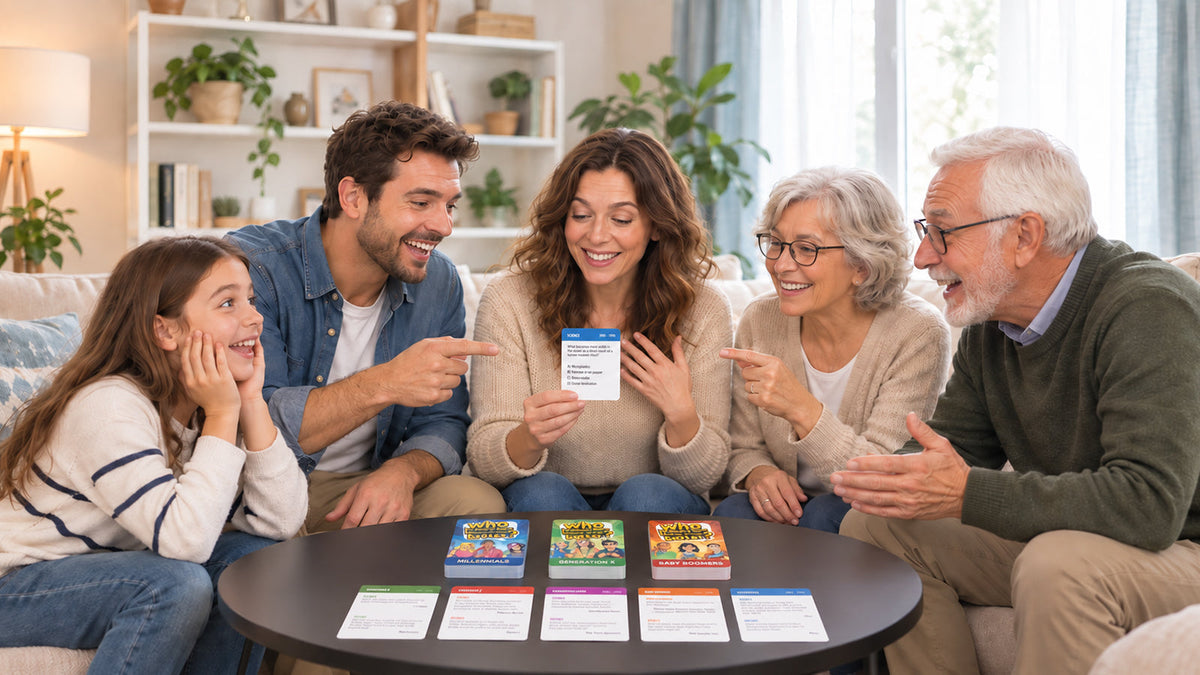
Five decks · one table
One extra rule turns a generational trivia deck into the family stories nobody thought to write down.
Have you ever wondered when the things you use every day were created? There are entire generations of people who can tell extraordinary stories of the changes they experienced during their childhood, youth, and adulthood — changes linked to events, objects, and much more. But who are these people?
They are our grandmothers and grandfathers, our moms and dads, and, of course, ourselves and our children. Every person lives in their own unique generation, one filled with unique things that always feel so new.
Ask your grandmother what it was like back then — and she'll tell you that everything was different. Ask her about a specific brand of soap — and you'll be there for twenty minutes: which store sold it, what her mother said about the price, and what the scent was like in the closet where it was kept. If a grandmother asks her grandson about the toy he's holding, he'll tell her the story of what the toy is and what it's for, and he might even tell her about the toys from her childhood.
The game “Who Knows Generations Better?” was created to strengthen the bond between generations. We may not even realize how much we know about the other generation and how many interesting events have already taken place in our own. When you ask a child about a song or a movie, they often answer correctly because they heard it when their dad was driving them to school or while watching an evening movie.
🗣️ Don't just answer. Say how you know
You can play the game “Who Knows Generations Better?” not just by going through the questions and answering them, but by turning it into a real story about each person at the table.
Nobody can just give the answer. They also have to say how they know it.
The kitchen, the back seat, a school corridor. The place comes back first, almost every time.
A parent, a sibling, a friend whose name nobody at the table has heard in thirty years.
A parent, a sibling, a shop window, a radio, or a school corridor.
What happens next is fairly reliable. The eleven-year-old answers a question about a song from 1974 and explains that it's what her dad plays when he's cleaning the kitchen, which everyone finds funnier than she expected. Her father, hearing this, remembers that he learned it from his father's car radio, and that his father used to drum on the steering wheel during one particular bar. The great-grandmother then says she was nineteen when it came out and can tell you what she was wearing. Three generations have just traced one object backwards through a family, and nobody had to sit anybody down for a talk about heritage.
The rule also fixes something quietly unfair about most family games. Usually the flow of expertise runs one way: adults know things, children are taught things.
The teenager
A question about slang from last year inverts that completely. The teenager becomes the authority and the grandfather becomes the student, in public, with everyone watching. Being genuinely useful to an adult is rarer than it should be at fifteen.
The oldest player
Often the least included in group activities — talked over, asked to repeat things, handed games built for reflexes they no longer want to prove. A generational deck is one of the few where age is the advantage rather than the handicap.
The parents in the middle
They end up as translators, which is a role they play constantly and rarely get credit for.
⏳ Nobody's timeline is objective
The second thing the game exposes is that everyone is wrong about when things happened, and wrong in a specific direction. We date objects from the moment we personally met them, not from the year they were made.
The same rotary telephone, on two different mental timelines
🧑🎤 To a sixteen-year-old
👵 To her grandmother
Sorting which decade something belongs to is genuinely hard, and being wrong out loud is where a lot of the laughing comes from. Teenagers regularly discover that the thing they've been treating as vintage was their parent's brand-new purchase, bought with real excitement, which is a strange feeling for everyone involved.
This is not only a dinner-table curiosity. Workplaces now routinely span four or five age groups at once, and most of the friction between them is exactly this: each group assumes its own reference points are the neutral ones. Care homes use the same mechanism deliberately, with era-specific music, photographs and everyday objects, because a familiar cue can reach someone that direct conversation can't.
There's also a body of research on families that knew their own stories. Psychologists at Emory University developed a simple “Do You Know?” scale asking children how much they knew about their parents' and grandparents' lives, and children who scored higher tended to cope better with stress. It's a correlation, so it doesn't prove the stories caused the resilience, and families that tell stories are probably different in other ways too. But it does suggest the stories are worth extracting while there's still someone at the table who can tell them.
🃏 One card from each deck
Guess out loud first — then tap to reveal. Notice who at your table gets which one instantly.
BoomersIn most homes in the 1960s, how did you change the TV channel?Reveal ▸
You got up and turned a dial. Remotes existed, but hardly anybody had one — the youngest person in the room was usually the remote.
Gen XWhy did people keep a pencil next to their cassette tapes?Reveal ▸
To wind the tape back in. Slot the pencil into the reel and turn — cheaper than replacing the tape, and it saved the batteries in the player.
MillennialsWhat sound meant nobody in the house could use the phone?Reveal ▸
A dial-up modem connecting. The internet and the landline shared one line, so getting online meant taking the phone off everybody else.
Gen ZIf a teenager says your dinner “ate” — is that good or bad?Reveal ▸
Very good. It means you completely nailed it. This is the round where the fifteen-year-old gets to explain something to everybody else.
Gen AlphaWhat is a “skin”, and why would a child pay real money for one?Reveal ▸
An outfit for a game character. It changes nothing about how the game plays — which is exactly the point. It's for the other players to see, the way a jacket was.
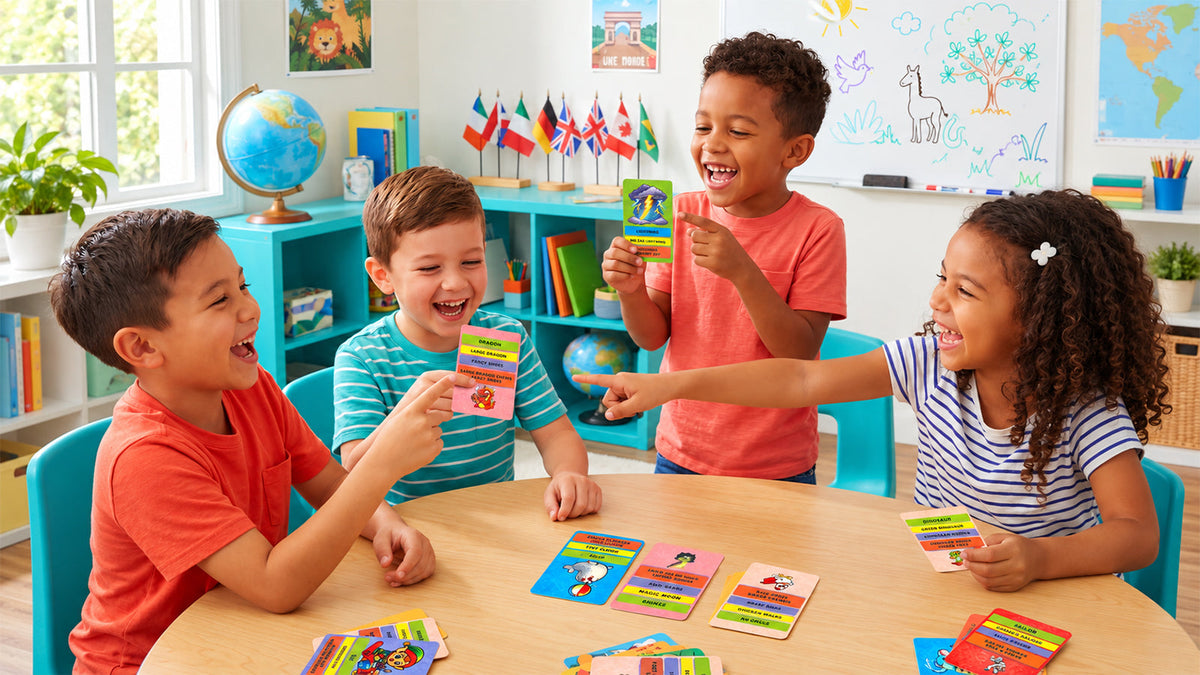
That's the honest case for a box of cards. Who Knows Generations Better? is built for this: questions sorted by era, so every player gets rounds where they're the expert and rounds where they're guessing. If the “how do you know that” rule turns out to be the part your family likes, Where Did I Learn is the deck built entirely around it. And the youngest players who can't yet compete on decades get their own version with Who Knows It Better? Kids, so they're playing rather than watching.
Who Knows Generations Better?
Six mini decks, sorted by era — so being the oldest in the room is an advantage in one round and a liability in the next.
Trends, history, science, entertainment, sports and pop culture — every player owns a section nobody else at the table can touch.
Shop the deck →Put a phone on the table recording audio, and don't tell anyone it's the reason. The score will be forgotten by Tuesday. The story about the car radio won't be recoverable at all in twenty years unless somebody kept it.
💬 Common questions
What age do you have to be to play?
How do you actually get grandparents to tell stories?
Do we have to keep score?
What if someone doesn't know any of the answers?
Get four generations talking at one table
Questions sorted by era, so everyone gets a round where they're the expert. Add one rule and it stops being a quiz.
Shop Who Knows Generations Better? →

Leave a comment
All comments are moderated before being published.
This site is protected by hCaptcha and the hCaptcha Privacy Policy and Terms of Service apply.